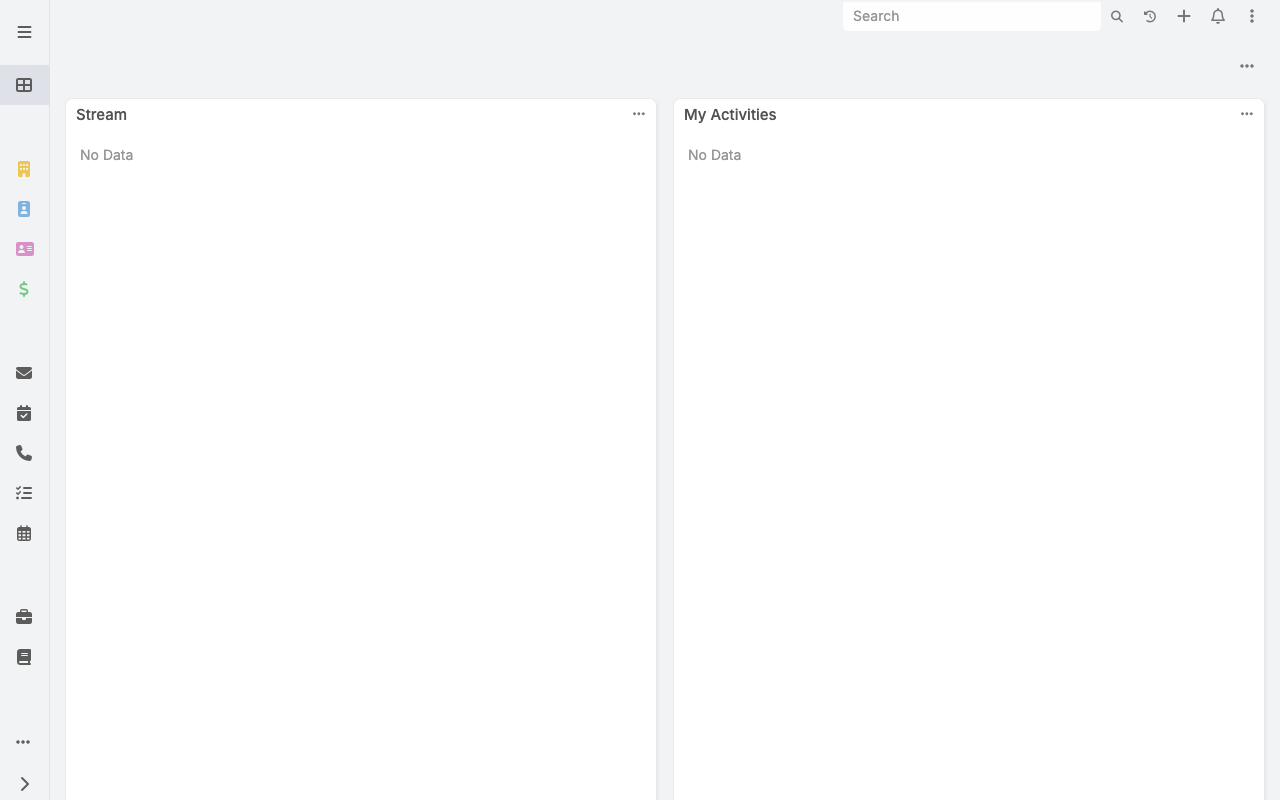
After signing in · Oct 21, 2026Sign-in page · Oct 21, 2026
About this app
A long-running contact and sales tracker with accounts, contacts, leads, calls and meetings.
Tested by Langford on Oct 21, 2026: Started from the project's published images and signed in as a new admin; the page showed "Stream". Read the test report
What it replaces
Salesforce
Zoho CRM
Information
Made by
Run and supported by Langford; built on open-source software
Category
Keep track of clients
Edition
Classic (one of 3 editions of Langford CRM)
Licence
AGPL-3.0
Data you can keep
Needs setup
Free for your business
Yes. Free open-source licence (AGPL-3.0); some add-ons are sold separately.
Suits
Insurance, Finance
Tested on
Oct 21, 2026
Built on EspoCRM, open-source software (AGPL-3.0). Source available.
Other editions of Langford CRM
All-in-one editionAn all-in-one office suite: clients, quotes, invoices, products and stock in one place.
Modern editionA modern contact and sales list: people, companies and deals, with notes and tasks on each.
Needs setup. Turn on sign-in rules and user roles before you store client records.
What “Tested” means
Started from the project's published images and signed in as a new admin; the page showed "Stream". Testing shows the app starts and signs in. It is not a security audit.
I run a:
Rules this helps you meet:NY DFS Part 500 — Safeguards in place on our hosting(full set after upgrade)
You hold policyholder and client nonpublic personal information (NPI), so your information security program has to cover where it lives. This hosting helps you meet parts of your state's insurance data security law (based on the NAIC model law) and, in New York, the DFS cybersecurity rule (23 NYCRR 500). Below are the questions you get from a market conduct examiner, a carrier or your E&O questionnaire, answered for Langford CRM · Classic.
What your examiner or auditor will ask
Is client NPI encrypted, both stored and in transit?
Yes. The database and file storage are encrypted at rest, and every connection uses TLS 1.2 or later. A setting that would weaken this is refused.
Can someone reach the client data from the internet without signing in?
No. The database and file storage have no public address; only this app, inside a private network, can reach them. Producers and CSRs get in only through the app's sign-in.
Do you require multi-factor authentication (MFA) for producers and CSRs?
Not by default. Turn on this app's own two-step sign-in if it has one. Our platform-wide sign-in with authenticator codes is designed but not built yet.
Do you keep audit trails of who accessed or changed records?
Our hosting logs every database and storage access to a separate archive kept 6 years. A per-user activity screen inside the app depends on the app; our built-in one is designed, not built.
Your written information security program and risk assessment. This page is evidence for it, not the program itself.
Deciding who gets access: add and remove producers and CSRs the day they join or leave, and give each one their own login.
MFA on everything else that touches NPI: email, agency management system, carrier portals.
Notifying the insurance commissioner (in New York, the DFS superintendent) within 72 hours of a cybersecurity event. That notice is the agency's job; we tell you what we see on our side.
Keeping this page and the check results in your vendor file for the examiner.
Rules this helps you meet:GLBA Safeguards Rule — Safeguards in place on our hosting(full set after upgrade)
You hold customer information, so you need a written information security program (WISP), and every vendor that touches the data belongs in it. This hosting covers on our side several elements of the Safeguards Rule under the Gramm-Leach-Bliley Act (GLBA): encryption, logging and monitoring, access limits and change control. For advisers and broker-dealers it helps you meet the safeguarding parts of SEC Regulation S-P. Below are vendor due-diligence questions answered for Langford CRM · Classic.
What your examiner or auditor will ask
Is customer information encrypted at rest and in transit?
Yes. Storage encryption is always on, and every connection uses TLS 1.2 or later.
Is multi-factor authentication (MFA) required for anyone who accesses customer information?
Not by default. Turn on this app's own two-step sign-in if it has one. Our platform-wide sign-in with authenticator codes is designed but not built yet.
Our hosting logs every database and storage access to a separate archive kept 6 years. A per-user activity screen inside the app depends on the app; our built-in one is designed, not built. Each customer's setup is also assessed continuously against the hosting rules.
BuiltDesigned, not builtEvidence: the checks below · our control listMaps to: FTC Safeguards Rule under GLBA (16 CFR 314.4(c)(8), 314.4(d)(2))
Is access limited to authorized users and systems?
Our side: the app's identity can reach only its own database and storage, and nothing is reachable from the internet except the app. Inside the app, row-level limits are designed, not built; use the app's roles.
BuiltDesigned, not builtEvidence: the checks below · our control listMaps to: FTC Safeguards Rule under GLBA (16 CFR 314.4(c)(1))
How are changes to the system managed?
Every change is code, pinned to an exact image, and recorded with who made it.
Do your records meet broker-dealer write-once record-keeping?
Not yet. Our audit archive is write-once (WORM), but its lock is not engaged yet, so it does not yet meet broker-dealer record-keeping rules. It also holds audit logs, not your business records.
Your written information security program (WISP), the person in charge of it, and your risk assessment. Our answers go in it; they are not it.
MFA on the rest of your systems: email, custodian and CRM logins.
Privacy notices and incident response for your customers.
Vendor oversight: keep this page and the check results on file, and re-check them each year.
The 12 checks we run
During your free 3 months your app runs on a shared server, so 7 of the 12 checks apply. The answers above describe a paid plan. Upgrading gives your app its own private database server and network, and all 12 checks.
Checked on our test setup on Oct 20, 2026. After your launch we run them again on yours.
Policyholder records sit on a private database no one on the internet can reach After upgradechecked on Oct 20, 2026
Client documents and policy files are kept in private storage with no internet address After upgradechecked on Oct 20, 2026
No shared password opens the file storage; only this app's own identity can get in After upgradechecked on Oct 20, 2026
The database refuses any connection that is not encrypted Free and paidchecked on Oct 20, 2026
The app only answers over encrypted (https) connections Free and paidchecked on Oct 20, 2026
Every change to policyholder records is written to an audit log Free and paidchecked on Oct 20, 2026
Policyholder records can be restored to any point in the last 35 days Free and paidchecked on Oct 20, 2026
Settings that would weaken any of this are blocked automatically After upgradechecked on Oct 20, 2026
Your setup is reviewed continuously against the security rules for your kind of data After upgradechecked on Oct 20, 2026
The app is up at its own secure address Free and paidchecked on Oct 20, 2026
Producers and CSRs must sign in before anything opens Free and paidchecked on Oct 20, 2026
A stranger who guesses a file's address gets “access denied” Free and paidchecked on Oct 20, 2026
Customer information is kept on a private database no one on the internet can reach After upgradechecked on Oct 20, 2026
Customer documents are kept in private storage with no internet address After upgradechecked on Oct 20, 2026
No shared password opens the file storage; only this app's own identity can get in After upgradechecked on Oct 20, 2026
Customer information is encrypted whenever it moves Free and paidchecked on Oct 20, 2026
The app only answers over encrypted (https) connections Free and paidchecked on Oct 20, 2026
Every change to customer information is logged and kept for review Free and paidchecked on Oct 20, 2026
Customer information can be restored to any point in the last 35 days Free and paidchecked on Oct 20, 2026
Settings that would weaken any of this are blocked automatically After upgradechecked on Oct 20, 2026
Your setup is reviewed continuously against the security rules for your kind of data After upgradechecked on Oct 20, 2026
The app is up at its own secure address Free and paidchecked on Oct 20, 2026
Nothing in the app opens without signing in first Free and paidchecked on Oct 20, 2026
A stranger who guesses a file's address gets “access denied” Free and paidchecked on Oct 20, 2026
Tested is not an audit. We check our hosting and test that the app starts and signs in; meeting these rules is still your program's job.
Langford test reportOct 21, 2026
Started from the project's published images and signed in as a new admin; the page showed "Stream".